Zito: ‘Back to doing what I do best’

SAN FRANCISCO –- He said he was fed up. No more than the fans were with him.

Barry Zito became the symbol of the San Francisco Giants’ failings, the big-ticket item on a medium-budget team who was tainted by a huge salary and doomed by a tentative fastball.

There were more things wrong with the Giants than Zito. When a team has four straight losing seasons, it isn’t because of one player. Yet Barry cost $126 million, and so at AT&T Park, he was treated roughly by spectators known mostly for their kindness.

Zito’s start Wednesday was going to be closely scrutinized, especially the way other pitchers in the rotation had performed on a successful home stand.

Four games preceded Barry, two of them shutouts, three of them victories. This was what the Giants had promised in the spring.

What Zito promised was open to skepticism. He knew it.

“Yeah,’’ agreed Zito, “I guess you could say it was important to have a good one, but it’s important to have a good one at all times.’’

Zito had a brilliant one, perhaps his best in two plus seasons with the Giants, although he begs to differ. Barry went seven innings without allowing a run or a walk. Eventually, the Giants got a pinch-hit single from Bengie Molina in the 10th to win, 1-0, over the San Diego Padres.

Reliever Brian Wilson picked up the victory. No less importantly, Barry Zito picked up the cheers. Although at 0-2 he still doesn’t have a victory, he does have his reputation. And considerably more respect. From the crowd.

His teammates insist Barry always had theirs, even when he dropped his first eight games last year and finished with a 10-17 record. Even when boos descended from the tiered stands alongside the Bay.

“It’s kind of tough when you’re in the limelight,’’ said Wilson, alluding to Zito. The two of them spent the offseason working out together.

“Today was the Zito I know,’’ Wilson continued. “The Zito I grew up watching. I’m pretty sure we can expect the same thing from all his starts now. His velocity is up. You can see the way he snaps his wrist. The hitters are a little behind it now.’’

What Zito had been behind was the eight ball. He had won a Cy Young Award in 2002 with the Oakland A’s. He seemed perfect to accept the role both as the Giants’ No. 1 pitcher and as the face of a franchise trying to escape the connection with Barry Bonds.

The problem was that Zito either couldn’t get the ball over the plate or got it over without velocity.

Thoughts of trying to justify the salary invaded his concentration. He’d make a mistake and suddenly three runs scored. It was not so much humiliating as bewildering.

“I was just trying to get back to what I do best,’’ said Zito, “which is pitch. I was getting fed up, pitching below my potential. But you just have to realize it’s not how many times you get knocked down, it’s how many times you get up.’’

He will be 31 in less than a month. He is starting his 10th major league season. He has never missed a start. For a long while, the spectators never missed a chance to start after him.

“I have to be aggressive and attack guys,’’ said Zito, who struck out seven including three in the fourth. “That’s something I did early in my career. I’m still healthy. I’m more than capable of having the same stuff I had earlier.’’

A week ago the Giants arrived home with six straight defeats and an ERA of more than seven. The suspicion was that their season was finished. Not quite.

They beat the Diamondbacks, 2-0. They lost to the Diamondbacks, 2-0. They again beat the Diamondbacks, 2-0. They beat the Padres, 8-3. Then Wednesday, to end the series, they beat the Padres, 1-0.

Five games, five runs allowed. “Pitching is what we’re built on,’’ confirmed Giants manager Bruce Bochy. “Zito hadn’t pitched well in day games here, but I think he put that all behind. He came in today and said he was going to be fine. He did the job.’’

Which is what a player is supposed to do, no matter how much he’s paid.

SF Examiner: Despite success, Sharks still get lost in Bay Area sports scene

By Art Spander
Special to The Examiner

This has always been the problem with hockey in California: A kid can’t go onto the playground, into the street or out in his backyard and play.

It is no exaggeration to point out around here that a surfing competition, Mavericks, receives more attention than a skating competition, the Stanley Cup.

One then is caught between fear and favor when even mentioning these words: San Jose Sharks.

The Sharks clearly are the best-run sports franchise in the Bay Area, a region where unfortunately front-office dysfunction is practically universal with perhaps another exception, the Giants.

The Sharks, indeed, are the only team in the last year in any sport with a winning record. This season they even had the most victories in the NHL, gaining something known as the Presidents’ Cup.

Yet the Sharks remain a virtual rumor except to the hockey cognoscenti, an intense, but miniscule group.

When the KNBR (680 AM) guy, Gary Radnich, is advised a caller to the program is “a hockey fan,” his immediate testing response is: “Name five players on the Sharks.”

If that is a sad commentary on our lack of sporting insight, well, we’re still musing about Joe Montana a decade and a half after his departure, but we remain clueless about another Joe — Joe Thornton — arguably the Sharks’ best player.

The Sharks sell out every game, or near enough to it, so nobody can be accused of distorting the truth when saying HP Pavilion is filled. But is anybody interested beyond the same 17,000-plus that attend?

And are the Sharks hurt as much by their locale as by their sport?

This is not a knock against San Jose, the most populous city north of Los Angeles. But what if the Sharks played in San Francisco, where they began? Would there be greater cachet? Undeniably there would be greater access for those in The City or Oakland or Marin.

The hockey crowd is wonderfully fanatical. The noise created when the Sharks score a goal will vibrate your eyeballs. It outdoes the roads from Warriors fans in the short-lived playoff of two years past or Giants rooters when Barry Bonds was driving balls into the stands.

Still, north of San Carlos, the team and the game seem more afterthought than necessity.

You hear people arguing about the Niners and Raiders draft picks, complaining because the Giants can’t get a big bat. But you don’t hear anyone, on air at least, discussing the Sharks.

The antidote surely would be for the Sharks to reach the Stanley Cup finals for once. Nobody jumps on bandwagons with the alacrity displayed by the fickle folk in this region who haven’t had a championship in any sport for years.

No playoffs recently for the Giants, A’s, Niners, Raiders or Warriors? Hey, Martha, what do they call that little black rubber thing people hit with sticks, and what is icing anyway?

The Sharks, however, lost the first two games of their current best-of-seven playoff series against Anaheim. Instead of becoming saviors for their sport in this land of milk, honey and growing unemployment, they seemed destined to be part of continuing parade of failures.

Just like the other teams in the Bay Area, except with less recognition.

Art Spander has been covering Bay Area sports since 1965 and also writes on www.artspander.com and www.realclearsports.com. E-mail him at typoes@aol.com.

- - - - - -

http://www.sfexaminer.com/sports/Spander-Despite-success-Sharks-still-get-lost-in-Bay-Area-sports-scene-43403872.html
Copyright 2009 SF Newspaper Company

RealClearSports: Washington Baseball: A 'Natinal' Disgrace

By Art Spander

Thirty years ago the great Frank Deford wrote of our Nation’s Capital: (1) Until recently Washington was a sleepy Southern Town. (2) It is recession-proof. (3) Nobody ever goes home.

To Mr. Deford’s three truths we add a fourth: Whatever the name of the baseball team and no matter who is on the roster, it has always been terrible.

But we’re only going back as far as the 19th century.

The newest entry, the Nationals – or as their name was misspelled on the front of some uniforms the other night, the “Natinals” – finally won another game. Its second in 12 attempts. And because of rain delays and a constant drizzle, the attendance at Nationals Park was 12,473. The smallest in its history.

But hang around. The old Senators used to have a pitcher, Walter Johnson, known as “The Big Train.” Now they’ve got a seamstress who’s “The Big Typo.”

These Nationals only have been in town five seasons. They used to be called the Expos and played in Montreal, another city that embraced baseball with, well, if that was passion, you’d hate to attempt to describe apathy.

Some would suggest five years isn’t long enough to judge the sport’s viability in a particular location. Let us then rummage through history.

We start with the Washington Senators, also called the Nationals, who were dropped from the National League in 1900 and accepted in the new American League in 1901. There used to be a maxim about Washington – General George, not the town on the Potomac. He was “First in War, first in peace and first in the hearts of his countrymen.” Corny, but there was no Comedy Central or YouTube in those days.

The Senators went to the World Series in1933, and after that had only two winning seasons in the next 25. The adage was revised to “Washington, First in war, first in peace and last in the American League.”

Novelist Douglas Wallop (now is that a baseball name or not?) in 1954 expressed the frustrations of Senators partisans with the book “The Year the Yankees Lost the Pennant.” An aging fan sells his soul to the devil to help the Nats beat the hated New Yorkers. America loved it more when it was transformed into the musical “Damn Yankees.”

“Ya gotta have heart,” the actor-ballplayers sang, which they had. And with “Shoeless” Joe Hardy, they also had a superstar before the creation of the word itself. Shoeless Joe from Hannibal, Mo., a combination of DiMaggio, Ted Williams, Barry Bonds and Albert Pujols, with a little A-Rod for good measure.

In 1960 those Senators, the real ones, not the stage version, were shifted to Minneapolis to become the Twins and recession-proof Washington was awarded an expansion franchise to be named, lo, the Senators. Confusing, but no one said the people in charge of baseball ever made a lot of sense.

Senators II lasted only a decade, until 1971, when they were moved to Texas and labeled the Rangers. So Washington was without our national pastime (if you ignore lobbying) another 25 years until the Expos crossed the border at the end of 2004.

Maybe instead of the Nationals, the ball club should have been called the Generals, who are the Harlem Globetrotters’ nightly foils. The Generals dropped something like 13,000 games from the 1950s to the 1990s. The Nats have a ways to go, but nothing’s out of reach. Including the skimming of signing bonuses from the Nationals’ Dominican prospects. Not enough the franchise is awful, some of the people involved apparently are unethical.

Jim Bowden, then the Nationals general manager – and a splendid job he had done – resigned at the beginning of March in the wake of investigations of whether baseball scouts and executives accepted kickbacks from the bonuses. As he departed, Bowden, reading a statement, denied “false allegations, insinuations and innuendoes by the press. There have been no charges made, and there has been no indication that parties have found any wrongdoing on my part.”

Not a lot of right-doing either, if you study the Nats’ record. But Washington, the city, not the general nor the Generals, seemingly has become immune to losing. It’s in the District of Columbia’s baseball DNA. For a hundred years Washington has lost either lost games or teams.

Now it has a relatively new team that’s a reject from Montreal, a team that opened the season with seven straight defeats and is so star-crossed it can’t even have the nickname spelled correctly on the home uniforms of Adam Dunn and Ryan Zimmerman.

Obviously in any new version of “Damn Yankees,” the old guy sells his soul for a tailor who can pass a spelling bee.
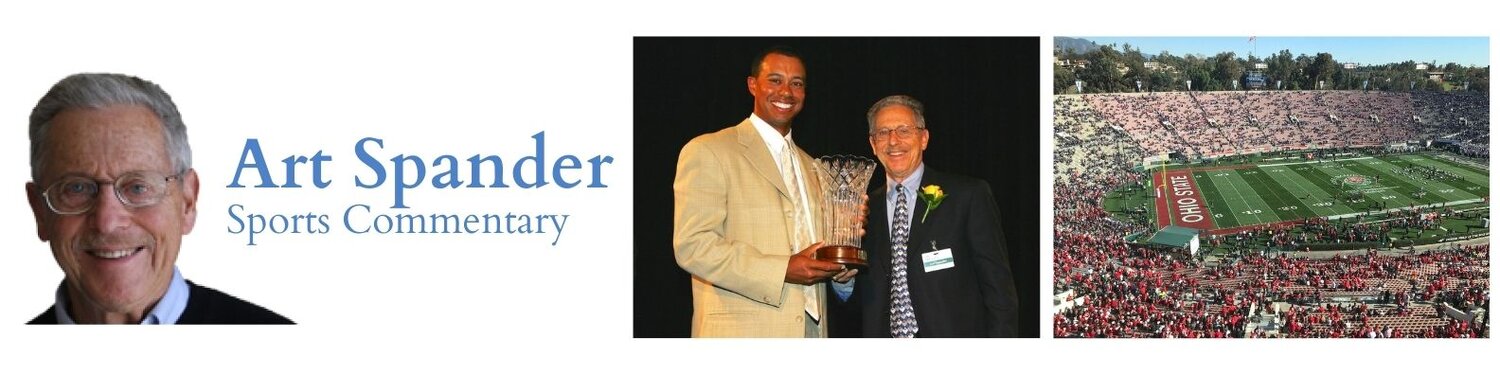
As a reporter since 1960, Art Spander is a living treasure of sports history. A recipient of the Dick McCann Memorial Award -- given for his long and distinguished career covering professional football -- he has earned himself a spot in the Pro Football Hall of Fame. And he has recently been honored with the Lifetime Achievement Award by the PGA of America for 2009.


- - - - - -


© RealClearSports 2009


Sharks in denial and in a hole after another loss

SAN JOSE – This is Sharks Territory. That’s what the signs tell us.


That’s what these playoffs tell us. Down here in San Jose, life and hockey would be so much better if there weren’t any postseason. Which, if the Sharks don’t begin to get some results, there won’t be in a short while.


Remember the way the Warriors stunned the Dallas Mavericks in the first round of the NBA playoffs a couple of years ago? What’s happened to the Sharks is the reverse. They have become the stunees.


Ask them,’’ San Jose coach Todd McLellan said of his group, “and I think they’ll tell you they’re the better team. It’s not like we’ve been spanked.’’


No, but they’ve been beaten. Twice. At home in front of sellout crowds whose anticipation turned to dismay, whose shouts turned into boos.


The Sharks finally scored Sunday night. After 85 minutes and 35 seconds of not scoring. This time they were beaten by the Anaheim Ducks, 3-2, which aesthetically may be more acceptable than losing 2-0, as happened Thursday night.


San Jose had the best regular-season record in the NHL. And at the moment a tie for the worst current postseason record. It’s a recurring nightmare for the Sharks, who lure everyone into thinking this may be the year and then go out and trip over their own intentions.


The Sharks are 0-for-12 on the power play, equally dividing their failings with six each game. Twelve different times they’ve had a man advantage, and 12 different times they’ve been unable to score. You don’t have to have been born in Canada to understand that’s not very good.


They’re beating us to the puck,’’ said the Sharks captain, Patty Marleau. The result is that Anaheim, known for physical play rather than success, has a 2-0 lead in the best-of-seven Western Conference quarterfinals.


And so San Jose players are firing clichés faster and harder than apparently they have the puck.


“Again,’’ said San Jose’s Joe Thornton, “I thought we controlled the game.’’


If he means hitting the puck, indeed. San Jose had 44 shots on goal, compared to 26 for Anaheim. If he means getting the puck past the goalie, absolutely not. You can persuade yourself that you’re doing a great job, but in sports the only thing that matters is who wins.


And in two games, the Sharks haven’t won any.


They shook up their lines. They were more aggressive. The first game the Sharks’ Jeremy Roenick described as a chess match.


This one was a hockey match, with plenty of banging and shoving. It was great theater. But it wasn’t satisfying for the 17,496 fans whose noise level ebbed in the final minutes. Except for the boos.


“Sometimes,’’ said Randy Carlyle, the Ducks coach, “it is more important to prevent a goal than score a goal in these tight games.’’ That’s the quintessential philosophy in the four major team sports. Defense beats offense. Keep the other guy from getting goals, baskets, runs or touchdowns.


The Giants won a couple of games over the weekend from the Arizona Diamondbacks because in those games the D-backs were shutout. In these games, the Sharks were shut down.


“The penalty kill is what they do,’’ said McLellen of Anaheim. “It’s very effective. We got to find a way to score, and that’s our biggest concern.’’


Anaheim’s young Swiss goalie, Jonas Hiller, has been brilliant. He stopped all 35 Sharks shots on Thursday night and 42 of the 44 Sunday night.


“There’s no magic to all this,’’ said the Sharks veteran Claude Lemieux. “You just have to get the puck into the net.’’


They understand the problem. Now they must go about correcting it.

EXCLUSIVE: Lincecum is back. Giants already are far back

SAN FRANCISCO – The curious contradiction of the Giants was never more in evidence than on a Saturday in April. The reassurance of Tim Lincecum’s beautiful pitching, now that he once again is healthy, was countered by the unnerving reality of another San Francisco defeat.

Tim Lincecum is back. All the way. He tied a career high with 13 strikeouts. He didn’t allow a run in eight innings against the Arizona Diamondbacks. The Giants also are back, in another definition of the word.

They are far back, 5 ½ games behind the Los Angeles Dodgers, and the second week of the season is not yet completed.

It’s axiomatic if the other team doesn’t score you can’t lose. Conversely, if your team doesn’t score you can’t win.

The Giants, with the Diamondbacks taking advantage of Lincecum’s departure and some incessantly depressing relief pitching, got a couple in the ninth and beat San Francisco, 2-0.

Ballplayers are quick to remind us not to dwell on one game. This one game, however, seemingly was indicative of the future. One game, in which the Giants acknowledged strength, pitching, proved ineffective because of the Giants acknowledged weakness, a lack of hitting.

In both the first and third innings the Giants couldn’t get a runner home from third with one out, not that for some inexplicable reason in the first Emmanuel Burriss didn’t try by ridiculously attempting to steal home only to be thrown out by 20 feet.

Of the four Giants infielders who started Saturday’s game -- including first baseman Travis Ishikawa (.172), shortstop Edgar Renteria (.189) and third baseman Pablo Sandoval (.195) -- only Burriss, the second baseman (.220), is hitting above the dreaded Mendoza Line of .200.

San Francisco now has lost seven of eight. It is not a reach to suggest the Giants may be out of contention by May. Starting Friday evening, the Giants shut out the Diamondbacks for 17 consecutive innings and lost one of two games.

“You’ve got to execute,’’ said Bruce Bochy, the Giants manager. Or to turn that around a bit, we steal from the late Tampa Bay Buccaneers coach John McKay who, after yet another defeat, was asked about his team’s execution and replied, “I think it would be a very good idea.’’

But what if the Giants are executing as well as they can? There’s no Albert Pujols or Manny Ramirez in the lineup. There’s no punch. There’s no pizazz. Every game is like walking atop slippery rocks through a stream, a lot of deep breaths and invariably a misstep.

It doesn’t get any better than Lincecum, the ’08 Cy Young Award winner, after being weakened by what was called lingering bronchitis. He was brilliant. It doesn’t get any worse than not being able to get a run and posting a team batting average of .239 for the season.

“He is so big for this ball club,’’ said Bochy. “That is no question. It is going to make us a better club having him healthy. With that being said, we have got to get some runs on the board. We are sputtering offensively. We had our opportunities the first three innings, and we couldn’t get a big hit.

“This is not a case where there is no hope.’’

One wonders. The Giants haven’t had a winning season since 2004. They are in a supposed process of rebuilding, advising that the organization’s minor league teams all are strong. Who cares? These are the major leagues.

A few weeks ago, the media was brought to AT&T Park to be told of the team’s environmental awareness. One garlic fries concession stand recycles its cooking oil. “We’re conscious of being very green,’’ said team president Larry Baer.

The rest of us are conscious of the ball club. It’s also quite green. Also not very good and offering no indication it will improve without large changes of the roster, and that is not going to happen.

“Sandoval is not going to hit what he’s hitting,’’ was Bochy’s contention. “Ishikawa... There are a lot of guys in the league that haven’t gotten going yet.’’

Too many of them are on the Giants, a team that needed to begin well both for its own confidence and in this year of the recession to keep the fans coming to games.

The hole in which the Giants can be located grows deeper. The forecast for the season grows all the more depressing.

“It’s tough for the team to take a loss like that,’’ said Lincecum of what transpired, “after a game like that. I was throwing strikes, and good ones.’’

And the Giants still couldn’t win.

Hello Fans of Art Spander, and sports fans in general!


As you can see (unless you are reading this via RSS) Art has moved the website to a new server, with a new design.  If you have not already checked it out, please do, and then leave us your comments here.  We’re new to this blogging thing – but we’re learning quickly, and your input goes a great deal in helping us provide an even better service to you, the reader.


“We” are the team behind Art, meaning his loyal fans, friends and family just like you, who are excited to see his popularity online growing, and want to encourage you all to take part in this new digital future.  Art is constantly in the thick of the action, whether it’s on the green with Tiger or on the manicured lawns of Wimbledown, at AT&T Park or Memorial Stadium, and now on his own site, he’s able to bring you all along with him.


Art has been a sports reporter for more than 4 decades and while he's moving to the online space along with the thousands of eager sporting fans we support, he’s still as committed to ever to the high standards of reporting and storytelling that got him here.  As such, we apologize in advance for the “digital dust” you may see while we move into this new space but we’re going to be releasing a number of exciting new features over the coming months, and we hope you will continue to show your support as we do.  If you have suggestions or really like what you see somewhere, let us know!


Before we let you go, we’d like to encourage you to check our Art’s Twitter stream at http://twitter.com/artspander, and  tell your friends to become a subscriber to this new site so you can become part of the conversation.

RealClearSports: John Madden: Great Announcer, Better Man

By Art Spander

He was the voice, whose love both of his sport and his work was open and infectious. John Madden didn't just make us understand football, he made us understand ourselves.


The NFL and its television broadcasts will go on because institutions inevitably outlast the people who bring them to popularity and prominence.


Yet, cliché as the phrase may be, things never will be the same.


Madden truly was the guy on the next chair in the restaurant, or the next stool in the bar, the guy who had to get into the conversation. Then, unpretentiously, unlike so many others because he knew what he was talking about, John simply took over.


Or to borrow a Madden observation, "Boom!''


At age 73, John on Thursday announced he was retiring from the broadcast booth, a property he seemingly had held in perpetuity for four different networks, the last being NBC on Sunday nights. It was there he and Al Michaels kept us informed and entertained.


Now as Kipling would have said, like all captains and kings, John Madden departs, with his class, to our sorrow. We're not only losing a football mind, we're losing a friend.


His family had something to do with the decision. He'll be married to the wonderful Virginia 50 years in December, and they have two sons and six grandchildren, whom, from August to January, were virtual strangers to John.


The two Northern California teams, the Oakland Raiders, which Madden coached to a Super Bowl win more than 30 years ago, and the San Francisco 49ers, also had something to do with the retirement. They have slipped so far from their championship years they're not considered worthy of Sunday night TV. Madden thus never was able to get back to his Bay Area home during the NFL season.


[ad#inline-468x60]

"I'm not tired of anything," said Madden, "but I'm going away."


So, this fall, for the first time since he was a freshman at Jefferson High in Daly City, the working class community dead south of San Francisco, John Madden will not be involved in football.


"What made it hard," he said during his morning radio spot on San Francisco's KCBS, "is I enjoyed everything so much. I always felt I was the luckiest guy in the world."


John Madden was everyman, with a sharper intellect. He liked to make us believe that on his cross-country bus journeys he only ate at places named "Joes," or slept in his clothes.


He is a closet intellectual who always made you feel good. Even when he was berating you, as he did now and then when he was Raiders coach and I was covering the team for the San Francisco Chronicle.


Some sporting leaders, coaches, managers, general managers, insist they never read the papers. Madden wasn't at all that disingenuous.


He'd come jogging and yelling across the Raiders old practice field in Alameda, waving the sports page and telling me in a few unsavory phrases I didn't have a clue what was going on. Then, when the workout ended, he would give me a clue and an explanation. Boom.


A few years back I was driving from Oakland to San Francisco, sitting in the line of traffic waiting to pass through the toll booths on the east end of the Bay Bridge. A horn sounded. And sounded again. Three lanes to my right, it was Madden, honking and waving - his arm, not a sports story he didn't appreciate.


John's pal from the time they were kids has been John Robinson, who went on to a successful coaching career himself, leading USC to Rose Bowl wins. "We were just a couple of doofuses from Daly City," Madden reminded of the pairing.


Part of their ritual among the group with which they ran was buying ice cream cones. "Another kid would yell 'First dibs,'" said Madden, "and he got to lick your cone. So we all would immediately lick our own cones to keep anyone else from getting some of yours. John Robinson would still eat my cone after I licked it."


Along the way, Madden has licked the world. He coached. He became a TV analyst. He did commercials for seemingly every product from Lite Beer - "Tastes great; less filling." - to Ace Hardware. He has a weekend home on the Monterey Peninsula. He owns huge hunks of the Diablo Valley beyond the hills east of Oakland. He was voted to the Pro Football Hall of Fame. He has an eponymous EA video game.


And arguably, he's the biggest star ever connected to the NFL.


"There's nothing wrong with me," Madden said about leaving, repelling in advance any stories that he has a medical problem. "I'm not tired of traveling. It's just this is the right time, the right thing."


We'll miss you, John.


As a reporter since 1960, Art Spander is a living treasure of sports history. A recipient of the Dick McCann Memorial Award -- given for his long and distinguished career covering professional football -- he has earned himself a spot in the Pro Football Hall of Fame. And he has recently been honored with the Lifetime Achievement Award by the PGA of America for 2009.
http://www.realclearsports.com/articles/2009/04/john-madden-great-announcer-better-man.html

© RealClearSports 2009

SF Examiner: Spander: The Three Cys letting Giants down in early part of season

Read original article at http://www.sfexaminer.com/sports/

By Art Spander
Special to The Examiner 4/15/09

SAN FRANCISCO – That should do it for the Giants, a team meeting. Why, of course. Bruce Bochy and the boys sitting around the clubhouse and telling each other they’re not as bad as they’ve been playing and exchanging ideas.

Someone might suggest to Randy Johnson while an 11 is acceptable at the craps table, it’s not what you want in an earned-run average.

It’s a good thing the Giants have Johnson and two other Cy Young winners on the staff, otherwise they might be in trouble with that lineup. One run Sunday, one run Monday. The pitchers are grinding their molars.

You are familiar with the Three Amigos and the Three Tenors. The Giants are offering the Three Cys. Or is that the Three Sighs? Johnson, an oldie but we believed a goodie, Barry Zito and the latest in line, Tim Lincecum, who earned the award in 2008.

So far in 2009, Lincecum is 0-1 with a 7.56 ERA, Zito 0-1 with a 9.00 ERA and Johnson 0-2 with that 11.42 ERA. In other words: Help!

Lincecum is the biggest worry. Johnson is in his 40s (age not ERA), and Barry, one of the good guys, has not been one of the good pitchers for the last several years. But Lincecum is only 24, in his third major-league season and, we’re told, headed for greatness.

The fear is there may be a few detours, such as expectations and the dreaded Cy Young jinx. (What, you don’t know about it?) So much was written and said about Tim, he was on the cover of Sports Illustrated, the cover of the Giants’ media guide. He may not be taking it all to heart, but rather trying to prove he is deserving of such attention.

“Something’s not clicking, and I’m going to figure it out,” was Lincecum’s forthright assessment. “You worry about things going on, especially in the present.”

For good reason. The Giants were winners only twice in their first seven games. While that was the same as the Boston Red Sox (and their zillion-dollar payroll), Milwaukee Brewers and Arizona Diamondbacks, it’s hardly encouraging.

San Francisco has finished with losing records four straight years as it wobbled through the departure of Barry Bonds and other travails. The hope in ’09 was for at least a winning record. The dream was for a place in the playoffs, but let’s not be ridiculous.

It’s a long season. Baseball cliché No. 1: It’s early. Baseball cliché No. 2: But once you get into a hole, unless you’re the Yankees or Cardinals, invariably you stay there. The Giants need virtually a week of wins to get even, and they’ve only played a bit more than a week of games.

The premise among the baseball mavens was the Dodgers, the hated Dodgers, had the bats, but the Giants had the arms, and that pitching inevitably will triumph over hitting. Oh? Is that why L.A. was an 11-1 winner over Frisco on Monday?

Any moment now, Giants GM Brian Sabean will be telling us it’s no time to panic. Hey, Brian, we’ll be the judges of that.

Art Spander has been covering Bay Area sports since 1965 and also writes on www.artspander.com and www.realclearsports.com. E-mail him at typoes@aol.com.

Copyright © 2009, SF Newspaper Company

http://www.sfexaminer.com/sports/Spander-The-Three-Cys-letting-Giants-down-in-early-part-of-season-43016437.html

RealClearSports: He Lost the Masters, But Won Our Hearts

By Art Spander

He lost the Masters. Kenny Perry was two shots ahead with two holes to
play Sunday, and we were thinking how fitting it would be, how
appropriate, if this 48-year-old with such great perspective, would
finally get his major championship.

He didn't. He lost the Masters. Kenny Perry, however, won our hearts.

Golf is the cruelest of games, a temptress, a harlot who waves a
beckoning finger and then slaps you across the face and shoves you into
the gutter. She'll snicker at your failure, showing not one iota of
respect. Or sympathy.

The 2009 Masters champion is that most underrated of pros, Angel
Cabrera. In a sentence, he's from Argentina and a wonderful golfer, two
years ago having won the U.S. Open.

Perry, Cabrera and Chad Campbell ended in a three-way tie at 12-under
par. Campbell bogeyed the first extra hole and was done. Perry bogeyed
the second extra hole, and the Masters was done.

Don't cry for us Argentina. Or, said Perry, for himself. Even though by
all rights he should have won. Because he deserved to win.

[ad#inline-468x60]

Perry grew up in Kentucky with a father who pushed him too hard to
excel. A father who, at age 85, with two stents in his heart, sat in
the shop of the golf course Kenny built for his home town, Franklin,
and suffered while the son he loves so much missed a second chance of a
lifetime.

The first was in his home state, at Valhalla Golf Club near Louisville,
where Kenny lost the 1996 PGA Championship (also in a playoff). That
loss pained him do deeply, lasted so long, Kenny put all his effort
last year into qualifying for the Ryder Cup at Valhalla, in an attempt
to regain the admiration of fans who wouldn't forget.

That accomplished - his play helped the U.S. win the cup and also
earned his family status as grand marshals of the Kentucky Derby parade
- Kenny said he could concentrate on winning a major.

Which he almost did. Which he should have done. But which he couldn't do.

Two shots ahead, two holes remaining. Not easy holes. Not at a killer
of a course, Augusta National. Not when you're a few weeks from your
49th birthday. Not when the only item lacking on your spectacular
resume is a major win.

Maybe he was nervous. Maybe he was weary. Perry bogeyed 17. Perry
bogeyed 18. Perry lost his lead. Then as darkness advanced onto the red
clay country of east Georgia, Perry lost the Masters.

But not his class.

"Two different situations," said Perry, comparing this disappointment
with that of '96. "I was young at Valhalla. Here I thought I had enough
experience. I thought I had enough to hang in there. But I was proud of
how I played. I really was."

And he should be proud. Perry came from tough times, and as a kid
didn't have the luxury of high-priced academy. He's raised a family and
with his earnings and raised huge sums for charity.

His father, Ken Sr., was an insurance man who, when Kenny was 7 or 8,
would sit on the grass, tee up one golf ball after another and make the
boy swing and swing. "He beat me up," said Kenny, meaning emotionally.
"He was a smart man. He knew you had to be tough."

And if there's anything Kenny Perry has displayed, it's his toughness,
repeatedly trying to qualify for the Tour back in the early 1980s,
winning numerous tournaments, including three last year and one this
year, and acting like a gentleman after what happened in the final
round of this Masters.

"I'm not going to feel sorry," he said. "If this is the worst thing
that happens out here, I can live with it. I really can. Great players
get it done, and Angel got it done.

"This is the second major he won. I've blown two. But that's the only
two I've had chances of winning. But I'm looking forward to (the U.S.
Open at) Bethpage Black. I'm looking forward to the British, to the
PGA. You know what? I can do it now, because it was fun."

For 16 holes it was. He didn't make a bogey for 16 holes under the most
intense pressure in one of the most prestigious tournaments on one of
the most difficult courses. Then he made two in a row.

"Our game's tough," Kenny Perry confirmed. But as we know, so is he.

"It's a mental game, and it plays a lot with your head. So I'm going to enjoy it. We are going to have some fun."

Even if he doesn't have the Masters.

As a reporter since 1960, Art Spander is a living treasure of sports
history. A recipient of the Dick McCann Memorial Award -- given for his
long and distinguished career covering professional football -- he has
earned himself a spot in the Pro Football Hall of Fame. And he has
recently been honored with the Lifetime Achievement Award by the PGA of
America for 2009.


- - - - - -


http://www.realclearsports.com/articles/2009/04/kenny-perry-lost-masters-but-won-hearts.html

© RealClearSports 2009


[ad]

Newsday: Tiger didn't have a swing, but still had a shot

By Art Spander
Special to Newsday

AUGUSTA, Ga. -- The dogged victims of an inexorable fate. That's the description of golfers made by the man who helped create the Masters, Bobby Jones. Sunday, this tournament of agony and joy beckoned the top two players in the world rankings and doggedly turned them into fate's victims.

It was a dream pairing for this first major of every year, Tiger Woods, No. 1, and Phil Mickelson, No. 2, two guys who give each other plenty of respect, but as noted from caustic remarks a few months ago about Phil by Tiger's caddie, not much love.

Tied for 10th at the start, they were too far behind to win, at least that's what we presumed. But first Phil, making birdies while a gallery 10 deep in places made thunderous noise, then Tiger, with a stunning eagle at No. 8, charged up the leader board.

Tiger, in his brief, unhappy appearance before the media, later said, "I almost won the tournament with a Band-Aid swing."

Mickelson, after a 6-under-par 30 on the front, then a shot into infamous Raes Creek at 12 to make double-bogey, would concede, "If I had gotten through 12 with a par, I was right in the tournament."

Both Tiger, who shot a 33-35-68 and Mickelson 30-37-67 were right in it. Then each stumbled.

Mickelson, who had been within a shot of first -- after starting out the seven shots behind, as was Tiger -- finished fifth and Woods tied for sixth. Phil's total of 9-under 279 was three strokes back of the three-way tie for first, and Woods came in at 8-under 280.

For Woods, who had complained the excitement was gone from the Masters when Augusta National was "Tiger proofed" by lengthening of nearly 500 yards over the last few years, the par-5s once again were his domain. Sunday, he made three birdies and an eagle on them.

But in un-Tiger like fashion, he bogeyed the par-4 17th and the par-4 18th, his third bogey in four rounds on the finishing hole. It has been four years since Woods won a Masters, the longest streak since he hit the sport like a hurricane with his record-setting victory in 1997.

"I hit it so bad warming up today,'' Woods said. "I was hitting quick hooks, blocks, you name it. Then on the first hole, I almost hit in No. 8 fairway. It's one of the worst tee shots I've ever hit starting out."

Yet, after birdies at 15 and 16, he was 10 under and within two shots of Kenny Perry. "I was right there," Woods said. But not for long.

Woods and Mickelson were the box office twosome. They started an hour before the 54-hole leaders, Angel Cabrera, who eventually was to win in a playoff, and Perry. Tiger and Phil seemingly had two-thirds of the Augusta crowd, a group which included Mickelson's wife, Amy, and Tiger's coach, Hank Haney.

"You just go about your own business," Woods said when asked if he could enjoy the battle. "Phil was obviously playing well, but still I was trying to post 11 under, shoot 65. Obviously, I didn't do it. My swing was terrible. I didn't know what was going on."

Then before another question could be asked, Tiger said, "Thank you," and, victimized, purposely walked away.

- - - - - -

http://www.newsday.com/about/ny-spmside1312647118apr12,0,4883916.story
Copyright © 2009, Newsday Inc.

Newsday: Despite being far back, Woods won't concede, yet

BY ART SPANDER
Special to Newsday

AUGUSTA, Ga. -- Reverie has met reality. Tiger Woods never should be declared out of any golf tournament, particularly a major, but right now, that idea has some serious limitations.

Surely he isn't going to win this Masters.

Not being seven shots out of first with one round to play -- although in 1956, Jack Burke came from eight back to win.

Not with players such as Angel Cabrera, who beat Tiger by a shot to win the 2007 U.S. Open; Jim Furyk, who won the 2003 U.S. Open and Kenny Perry among the nine players ahead of him.

Not the way Tiger has handled, well mishandled, the difficult greens at Augusta National. One of the game's best putters, if not the very best, Woods is 43rd in the field in putting after 54 holes.

After shooting a 70 yesterday, he is tied for 10th at 4-under-par 212, looking up, way up the leaderboard at Cabrera and Perry, who are at 11-under 205.

Tiger could shoot 64 or 65 Sunday, but as Woods, who never makes concession speeches, agreed: "If Kenny and Chad [Campbell] go off and shoot 2, 3, 4 under from where they are, it almost puts it out of reach for us. If they come back a little bit or stay where they are, we've still got a chance."

Campbell and Perry had been tied at 11 under while Cabrera was 10. Then Cabrera and Perry were at 11 under and Campbell was 9. Either way, all three are not going to collapse. One, perhaps, but not all three. And though Furyk (8 under) may not be Tiger, he is one of the world's best.

This Masters was a special test for Woods, only his fourth tournament since returning from ACL surgery on the left knee, only his first major since returning.

He won at Bay Hill two weeks ago, and the pundits declared him not only ready but the favorite.

Saturday, he opened with a double-bogey, whacking his first tee shot into the left trees, getting to the green in three and then three-putting. That he eventually had a decent 2-under 70 with five birdies can be considered impressive, if not successful.

"I fought hard to get it back," Tiger said. "I'm pretty proud of the fact I got myself back in the tournament, considering I didn't hit it as well as I wanted to and had two three-putts."

Since he broke through with his first major title in the 1997 Masters, Tiger has never gone more than three Masters without winning. But he hasn't won since 2005.

He appears out of sorts, Friday displaying considerable anger after bogeying 18 a second straight day. The question was whether Woods was not yet major-tournament ready. The answer was the usual. Self-doubt has never been allowed by Tiger Woods.

"No," he said, "It's not that at all. Not at all. I just didn't hit the ball as precise as I needed to [Saturday] and just fought my -- off to get it back, to shoot a number.

"As I said, I'm very proud of that. After making a double on the first hole, to still get myself in, well it depends on what the leaders do whether I've got a chance or not."

So far, it has depended on what he has done. And he hasn't done enough.

- - - - - -

http://www.newsday.com/about/ny-sptiger1212645835apr11,0,7238622.story
Copyright © 2009, Newsday Inc.

Scotland Sunday Herald: Quadruple bogey puts paid to the Paddy slam

US Masters: Harrington challenge fades after nine on par-five second hole, writes Art Spander

PADRAIG HARRINGTON'S slim hope of winning a third straight major championship perished on a hole with the benign name of Pink Dogwood. The Irishman, who won both the Open Championship and American PGA Championship in 2008 and was one of the favourites in the Masters, took a quadruple-bogey nine yesterday on the 575-yard par-5 second hole of Augusta National.

That after his misfortune on Friday, when, having grounded his putter on the green of another par-5 hole, the 15th, with a good chance for a birdie, he watched as a swirling wind moved the ball and he was charged a stroke.

But yesterday it was Padraig, not nature's whims, which did him in. The green of the second, after a long drive, often can be reached in two. Harrington, though, reached it in seven.

He pulled his drive deep into the pines but had good lie. The second shot ricocheted off a tree trunk and plopped into a bush, from which Harrington could not extricate himself and therefore took a penalty drop.

His fourth hit the same tree as his second. His fifth barely made it out of the woods. The next shot was short of the green. Then he chipped on and two-putted.


That, however, was the only over-par hole on the front nine for Padraig, if indeed four-over par, and with the help of three birdies, on five, eight and nine, he still managed a one-over 37.

Rory McIlroy, the 19-year-old Ulsterman, had his troubles on Friday, closing with a double-bogey 5 on 16 and a triple-bogey 7 on 18 and then nearly being disqualified over a possible rules breach.

But for the third-round yesterday, McIlroy, in his first Masters, shot a one-under 71 for a 54-hole score of even-par 216. In his agonising second round, McIlroy, temporarily in sixth place, four-putted the par-3 16th. At 18, in the midst of making the triple, he left a shot in a bunker then kicked at the sand with his right foot, which immediately prompted a BBC analyst to wonder whether he had violated a rule prohibiting players from testing the sand.

Brought back to the club around 8.40pm, after a committee of rules officials had viewed a video tape, McIlroy, having already been questioned on the phone, explained in person he had not kicked the sand in anger but only as par of housekeeping.

The Rules of Golf (13-4) allow "the player to smooth sand or soil in the hazard after making a stroke provided that, with regard to his next stroke, nothing is done to improve the position or lie of his ball". McIlroy, whose 72-73-145 was right on the cut line, said he never feared he would be disqualified. "No,'' he told the BBC, "because I was confident that I hadn't done anything wrong. I think they just needed an opinion from myself. I don't think it was that big a deal.'' More than 40 years ago, 1967 to be exactly, Arnold Palmer, then still a force, similarly left a ball in a bunker but in anger slammed his wedge into the sand. Officials were going to assess him a stroke for the action, but Augusta has always been kind to Arnie and officials decided "he was not testing the hazard since he already had taken a swing'', and retracted the penalty.

Sandy Lyle yesterday looked more like the 51-year-old he is, with a one-over 37 on the front nine, than the golfer who on Friday ran off five straight birdies, holes 13 through 17, which gave him a 32 on the back nine and a two-under-par 70. "Even when you play well it is still hard work,'' said Lyle, winner of the 1988 Masters, "and under-par is nerve-wracking. I was hoping to get through Amen Corner and knew I could pick up shots on par-5s, but I didn't expect to finish like I did."

Ross Fisher's ride was interesting if unsteady. The Englishman began with a three-under 69 and then as might be expected in his debut Masters, came back with a four-over 76. He improved a bit yesterday with a 73 but is at two-over 218.

"I gave myself chances," Fisher said of his experience. "You get good looks on the greens, but I just couldn't get the speed." Tiger Woods, a four-time Masters champion, was saying virtually the same thing. But at least, unlike the last couple of years, the weather is pleasant and the roars for birdies noticeable.

Another Englishman, Luke Donald had the honor Friday of playing with Gary Player in the last round of his 52nd and final Masters. The 73-year-old, who stopped and knelt at the edge of the 18th green as he closed out his Masters career, had an 83 for 161. Four years ago, Donald was in the grouping with Jack Nicklaus at St Andrews when Jack bowed out of the Open championship. "I'm not sure why I keep getting picked," said Donald. "Maybe I'm the nice guy." Donald enjoyed himself, even though he just made the cut with an even-par 144.

- - - - - -

http://www.sundayherald.com/sport/nationalsport/display.var.2501473.0.quadruple_bogey_puts_paid_to_the_paddy_slam.php
©2009 newsquest (sunday herald) limited.

Tough love made Kenny Perry a tough golfer


AUGUSTA, Ga. – Cigar
smoke is what Kenny Perry remembers. He was "probably seven," and his father,
intense but not abusive, and determined to make his boy a winner, would sit on a
towel, tee up ball after ball and all the while puff on a cigar.


"I would hit them as
fast as I could," said Perry, "and we did that hour after hour. I still smell
the cigar, the grass. Any time I catch a whiff of all that, my dad instantly
comes to me."


Kenny Perry is tied
for first place two rounds into this 2009 Masters. He shot a 5-under-par 67
Friday and, at 9-under-par 135, shares the lead with Chad Campbell.


His father, Ken Sr.,
85, is back in Kentucky, with two stents in his heart. And though Kenny, who's earned more
money playing golf, $28.1 million, than anyone who's never won a major, says he
would be satisfied if his career never went another day, his father continually
reminds him, "You need to win that green jacket."


Which of course is
what the Masters champion is awarded.


Kenny Perry is 48,
and in 1986 Jack Nicklaus, with his sixth Masters victory, became at age 46 the
oldest ever to win the tournament. Perry said he isn't thinking of making
history.


He is thinking of
finishing first.


After finishing a
year of redemption, countering criticism and playing so beautifully and
meaningfully in the 2008 Ryder Cup in his home state, at the very course,
Valhalla were Perry incurred his most wretched defeat, he and the family have
been named Grand Marshals of the Kentucky Derby parade.


"You know everything
is a bonus now," said Perry. "I'm going through each and every day enjoying
life a little bit. I think I can win. I'm still burning inside, wanting to kick
everybody's butt. I've got a will inside of me. My dad taught me. He beat on me
so bad as a kid in any kind of game or sport, I cried all the time. And then he
would laugh in my face as he was doing it.


"You know, he was a
smart man. And at the Ryder Cup when he came up to me and gave me that hug, I
told him it was the greatest gift I could never have given him. That was pretty
special for us as a father and son."


Ken Perry Sr. was an
insurance agent. His greatest talent, it turns out, was selling his son on how
to make it through life, to steel him for whatever might come, as the fictitious
father of song who named his boy Sue.


Kenny Perry Jr. is a
golfer who didn't have the luxury of a high-priced academy, a pro who has raised a
family – three children, the youngest of whom still is older than 19-year-old
Rory McIlvoy, the Irish golfing phenom – and raised huge sums for charity. Kenny Perry's outlook is different from
that of others.


"Where I came
from," said Perry, "the roots I had and my upbringing, to come from a nine-hole
course in the middle of nowhere ... I didn't have swing coaches. I didn't have
this entourage. I didn't have any money, begging, doing whatever I could,
scratching and clawing to get there."


It was 13 years ago
at Valhalla, the course outside Louisville, 130 miles from the Perry residence
in Franklin, where in the PGA Championship Kenny had his greatest opportunity to
take that major. He finished early the last day and, glib sort that he is, was
persuaded to climb into the TV booth while play continued.


He still was there
when Mark Brooks came in to tie Perry, who not having hit a ball in the
preceding hour, was not ready for the playoff won by Brooks.


"Yeah," he
conceded, "I think about it a lot."


So do others. Perry
was so obsessed with atoning for his failure when Valhalla hosted last
September's Ryder Cup, he didn't even attempt to qualify for the U.S. Open and
then, even though exempt, passed up a spot in the British Open. For that he was
ripped in the media. He didn't care.


"I laid all my cards
on the line that week," he said of the Ryder Cup experience. "I put it all on
the line, being in front of my home crowd. I mean I could have been a dog that
week and gone 0 for 4 or 5 and not won a point. I put all the pressure I could
on myself.


"People remember the
debacle at the PGA, how I screwed that up, and all of Kentucky remembered me for
that. I was going for broke, either was going to hit a home run or get thrown
out. And it went my way. Things went my way."


They haven't stopped
going his way. Having missed the cut five of the previous times he played here,
Perry gleefully declared, "At least I can tell everybody I led the Masters once
in my life."


Some stop to smell the flowers. For Kenny Perry, it's cigar smoke.

Greg Norman's Masters return brings cheers and memories


AUGUSTA, Ga. – It was difficult to tell whether the response to Greg Norman on his return to his beautiful hell, applause and cheering so loud and enthusiastic, was out of admiration or sympathy.


"Everybody wants to live in the past," Norman said Thursday, answering a question about what might have been had he not come apart in that final round of the 1996 Masters, a final round he doesn't want to remember and no one else wants to forget.


So many chances to win this major played out beneath the Georgia pines, golf's tribute to spring and history.


Norman was the man of a decade, from the mid-1980s through the mid-1990s. Always in contention. Often in frustration.


Jack Nicklaus edged him by a shot in the '86 Masters, then a year later Larry Mize holed a chip to win over Greg in a playoff. Then after we spent seasons taunting Norman with our thoughts and analysis, he constructed a six-shot lead over Nick Faldo with 18 holes remaining.


At last, we believed, there would be redemption. Instead there was more agony. Faldo not only beat Norman, he beat him by five shots.


Greg returned another half-dozen times, even coming in as high as third in 1999, but then his life changed. There were injuries. His marriage was unraveling. He concentrated on his numerous businesses, from turf grass to boat building. The Masters was left in the distance, his last appearance in 2002.


Until now. Until gaining a place in the field through a surprising third-place finish in last July's British Open. At 54, Greg Norman was back to challenge the greens and demons. In the first round, he met that challenge, shooting a 2-under-par 70.


And naturally, someone wondered, euphemistically of course, if Norman had played that awful final day in 1996 as he did this wonderfully reassuring first day in 2009, "what you might have shot on an earlier Augusta National."


Norman was not fooled. He understood the meaning, and he offered his punch line about us living in the past.


It's a different Greg Norman now. He said his marriage to retired tennis star Chris Evert, after a $100 million divorce from his wife of some 25 years, Laura, has proven to be stabilizing.


Chrissie's calm approach, understanding of competition and willingness to accept Greg's hours of practice, have been a balance Norman said had been lacking.


Greg and Chris talk to each other like husband and wife, and athlete and athlete.


"She wishes she could get back out there and play," said Norman, who in contrast has gone back out there and is playing, "because she sees the passion I have, and I'm at the age – we are both at the age – where golf allows me to do it, or my sport allows me to do it for whatever crazy reason."


And Evert, also 54, unable to race about a court as she did three decades past, finds vicarious success in Norman's golf. "She can still hit all the shots," he said. "But she feels, especially now, she loves the competition, wants to make sure everything is right around me. Because she's been there and done that and wants nothing more than to see me just happy playing golf, whatever happens on the course."


What happened Thursday was Norman had three birdies and only one bogey. And at each green and each tee, the crowd was more than gracious, it was excited.


"Hey everybody loves me," joked Norman. Nothing wrong with that is there? Are you guys jealous?"


Greg, with his swashbuckling ways, with his nickname, "The Great White Shark," was forever a favorite. He took chances. He took figurative blows to the jaw.


"No matter where I play in the world, I've been connected to the gallery," said Norman. "I play with my heart on my sleeve, and I've done very well out of the game. And when I come here, people probably feel for me – some of the things that have happened here -- and really enjoy seeing me back here.


"I played my way into this tournament, which very few people can say at age 54, and it's a feather in my cap, to say the least. A seven-year hiatus, and it feels like the very first time I played here."


That was 28 years ago, 1981, and Norman, albeit on a more receptive course not toughened and lengthened, shot a 69, only one stroke better than the last time he played here, Thursday.


Norman, in his 22 Masters, has finished second three times and third three times. So close. And too far.


"Can a 54-old-man win this golf tournament?" a journalist asked Greg Norman in closing.


"We'll have to wait and see," Norman said with a shrug.

Or, knowing what the Masters has done to Greg, wait and hope.

SF Examiner: Tiger injects life into the Masters


AUGUSTA, GA. – One word. One name. Tiger. And it all changes, in golf, in sports. One name, and we’re thinking differently. One name, and we’re paying attention again.


One name, and the game is on.


It’s not a comeback for Tiger Woods. Not at the Masters. He was here in ’08, as in ’07 and the 12 years before that, two as an amateur.


He missed golf for eight months, June to February, recovering from knee surgery. And certainly golf, so dependent on individual stars, missed him.


But here under the Georgia pines, here where Amen Corner lurks, here where history can be found on virtually every magnificently trimmed fairway or hellishly fast green, it’s as if nothing has changed. Because nothing has changed.


Tiger is playing and thus, weeks of rehabbing and months of doubts to the contrary, Tiger is the favorite.


What a great few days in sports, the Final Four, the beginning of baseball season, the Masters. A tradition like no other, CBS tells us. Tiger Woods, a golfer like no other, and nobody needs to tell us.


What the fans tell Tiger, shout it out, is “You’re the man.” Which he is. Golf is dozens of great players, Phil Mickelson, Anthony Kim, Geoff Ogilvy, Greg Norman, returning to his scene of heartbreak. Golf is one person, Tiger Woods.


Does he do it this week, win a fifth Masters, a 15th major? Or does he fail, and his short streak without a Masters victory extend to four, which would be the longest since he turned pro and, with that crushing triumph in 1997, turned golf upside down?


Either way, Tiger becomes the tale, the focus. Either we’re going to say, “How about Tiger?” or “What happened to Tiger?” The world distilled into good and bad, right and wrong, Tiger or not Tiger.


The Giants and A’s have started their long season.


The 49ers and Raiders are trying to figure into the NFL Draft. All of it is interesting, as opposed to Tiger, who is compelling.


Golf, as tennis, is constructed on personalities. Arnie took the game out of the country clubs. Jack Nicklaus awed us with his success. Greg Norman was exciting, sometimes in a negative way. Then along came Tiger, breaking par, breaking barriers, becoming as much a symbol of progress as a champion athlete.


And now here he is, and here the Masters is, and we can’t help but pay attention and perhaps pay obeisance to arguably the finest golfer ever and maybe the best-run tournament ever.


The Masters the last couple of years hasn’t been as exciting as we remembered. The weather was cold. The course had been toughened. The familiar roars of appreciative fans were lacking.


Tiger the last three years wasn’t quite as exciting at the Masters as we preferred, although two third places and a second isn’t exactly a collapse. More a tease.


“The last couple years, my putting has been streaky here,” was Tiger’s explanation before today’s first round. “I got on rolls where I make everything, and I get on rolls where I didn’t make anything.”


For sure, Tiger has made himself impossible to ignore.


Art Spander has been covering Bay Area sports since 1965 and also writes on www.artspander.com and www.realclearsports.com. E-mail him at typoes@aol.com.

- - - - - -

http://www.sfexaminer.com/sports/Spander-Tiger-injects-life-into-the-Masters-42715287.html
Copyright 2009 SF Newspaper Company

RealClearSports: The Best of Sporting Times and Tigers

By Art Spander

Our Aprils, contrary to the T.S. Eliot poem, never are cruel. In the space of a few days they give us a sporting mixture that is irrepressible, full of baskets, fast balls and here, beneath the pines of Augusta National, 300-yard drives that confirm, no matter what the conditions, spring has arrived.

The NCAA Final Four, with its oversized crowds came first, and were followed by the baseball openers teasing the long season to come. Now, at a site as legendary as the men who have competed here, the Masters.


Now Amen Corner, Hogan Bridge and the man whose very presence has transformed golf into more than a weekend pastime, Tiger Woods.


Have we come down from North Carolina’s brilliant victory over Michigan State? Or Francisco Rodriguez’ excellent relief performance in his first chance for the Mets? It is time to get up once more, to follow Phil and Padraig and particularly, Tiger. Time to pay attention to the 12th hole, called by some the most difficult par-3 in golf, and to greens that as Dan Jenkins once wrote, are as slick as the top of Sam Snead’s bald head.


There is a special fascination with the Masters as the first major tournament of every year. The name itself lends a cachet not found anywhere else in sport.


Golfers last a lifetime. Jack Nicklaus won a Masters at age 46 and was playing the tournament well into his 60s. Greg Norman is back this time, and even the most callous of individuals finds sympathy for a man in his 50s known less for success than for his failures, including that 1996 Masters, when he blew a six-shot lead the last day.


We are familiar with so many of them -- last year’s winner Trevor Immelman, and Vijay Singh and names which persist like the blooms of the dogwood trees.


We remember when Tom Weiskopf took a 12 on that 13th hole, and when Mickelson made that winning putt on the 18th and jumped, what, all of three inches? And we remember when, in 1997, Tiger crushed the scoring record, sending a signal that golf would never be the same, as he became the first African-American to win the Masters.


Since then, it’s been all about Tiger, and this year -- the year of the great return -- the focus is even greater. From his first shot in Thursday’s opening round to his last, he will be the focus, and perhaps the champion. He was gone eight months after surgery on that anterior cruciate ligament and legitimately or not, because we should be wary of doubting the great ones, there were questions of whether he would be his old self. They were answered quickly enough.


Tiger stood over that 15-foot putt nine days ago on the 72nd hole at Arnold Palmer’s tournament and seemingly as if predestined, knocked the ball into the cup to win. The way he had done before the layoff. The way he always will do.


“I really wanted to get into contention,” Woods said Tuesday of his victory, “and feel the rush again on the back nine. I was not in it at Doral; I was on the periphery. The past week at Bay Hill was great to feel that, and to see how my body would react again. It’s been a while and a lot of uncertainty over the months upon months of rehab. And it felt great to hit shots.”


Uncertainty? With Tiger Woods? Deep down, he knew. So did the rest of us. He was going to win again. It was inevitable. That he needed only three tournaments was maybe a surprise. Or was it?


I learned not too long ago, never to be unsure of Tiger. It was the 1996 U.S. Amateur, his last before turning pro a few days later. He was 5-down in the final, at match play, and on a radio broadcast I declared his reign, after winning the previous two years, was at an end.


Not at all. Woods caught Steve Scott and won on the second extra hole, the 38th. Scott could only sigh, “Against Tiger Woods no lead is safe.”


A couple days later, Willie McCovey, the Hall of Fame baseball player, confronted me and said, “How could you give up on Tiger? I don’t care how far teams and players get behind, when they’re good you have to believe in them.”


I believe. Tiger may not win this Masters, but who wants to pick against him? In these wonderful few days of April 2009, not me.


As a reporter since 1960, Art Spander is a living treasure of sports history. A recipient of the Dick McCann Memorial Award -- given for his long and distinguished career covering professional football -- he has earned himself a spot in the Pro Football Hall of Fame. And he has recently been honored with the Lifetime Achievement Award by the PGA of America for 2009.


- - - - - - 

http://www.realclearsports.com/articles/2009/04/best-of-sporting-times-and-tigers.html
© RealClearSports 2009

RealClearSports: North Carolina is a Quick Winner

By Art Spander

This was one in which reality crushed reverie, power overwhelmed hopefulness. This was one in which the best college basketball team in the land proved it was the best college basketball team in the land, and the experts knew exactly what they are talking about.


Over the weekend, we had been immersed in the tale of Michigan State, and how its ascent was being felt by this city that once was the proud hub of a flourishing auto industry, but now reflects all the problems of America’s stumbling economy. It was going to be so glorious, so uplifting when the Spartans came through. But they could not. North Carolina never gave them a chance. The Tar Heels ran and jumped and harassed. And Michigan State was in a state of bewilderment.


In the end, Carolina won 89-72, took its fifth NCAA basketball championship, finished as the Final One of the Final Four, verified that indeed as in October’s preseason polls and now in April’s glory, the Tar Heels are an unquestioned No. 1


They hit quickly and hard, stunning not only Michigan State, but a record crowd of 72,922 at Ford Field, the majority of which naturally was cheering for the Spartans. Carolina was up 22-7 within six minutes gone; then 34-11 with 9:44 to play in the half.


Would the Tar Heels score 100? Maybe they should have. Would they beat State worse than in December, when Carolina, in the very same building, the home of the NFL Detroit Lions, dismantled the Spartans, 98-63? Maybe they could have.


“They’ve kind of given us our lunch, haven’t they?" Tom Izzo, the Michigan State coach asked with great prescience the day before the game. “But that’s because they’re a great program."


The greatest going this season.


Sunday night, Roy Williams, the Carolina coach, dined on fried lobster at the Detroit Fish Market for the second time in 48 hours. “I’m not superstitious," Williams said when confronted as he left the restaurant, “but I ate here Friday night and I didn’t want to take any chances."


With the team he put on the court, there were no chances to be taken. Carolina forced a supposedly disciplined State team into 21 turnovers. “Fourteen in the first half," said Izzo. “We couldn’t do anything. I was disappointed. I also thought we missed some good shots early. I thought we looked either shell-shocked or worn down."


The championship was a reward for Carolina players such as Tyler Hansbrough and Danny Green, who ignored opportunities to join the NBA and came back for a senior season of not so much retribution as relish.


The 6-foot-9 Hansbrough, last season’s Player of the Year, was castigated because he did not lead Carolina to a title. When Williams was asked if that would diminish Tyler’s career, he was adamant in his denial. “Ernie Banks never won a World Series," Williams reminded.


But now Hansbrough has won an NCAA, and when the final seconds ticked off and the confetti was shot from those special air guns, he was a little kid beside himself, belying a reputation for a lack of emotion.


“This was the best way to go out," Hansbrough shouted into a CBS television microphone, “after what we had been through. We climbed all the way." Hansbrough had 18 points, behind Ty Lawson’s 21 and Wayne Ellington’s 19. Center Goran Suton scored 17 in his last game for Michigan State.


“We couldn’t stop Hansbrough inside,” said Izzo, “and we couldn’t stop Lawson from getting to the line.” Lawson got 18 free throws and made 15 as he drove inside and drew foul after foul.


“All I know,” said Williams, who has led Carolina to two championships in his six years after moving there from Kansas, “is I’m the luckiest coach in America. I am so proud of this team. We overcame a lot during the season."


They also scored a lot. Eight times Carolina reached 100 points or more, and when the Heels led Michigan State 55-34 at intermission, it appeared inevitable they would do it a ninth time. But Carolina got a bit loose and sloppy, and so the rout became merely a one-sided victory.


Magic Johnson, the Michigan State alum, and Larry Bird were in the building on what was the 30th anniversary of their memorable battle in the 1979 NCAA championship, won by the Spartans over Bird and Indiana State. And Michael Jordan, a Heel, David Robinson, Vivien Stringer and John Stockton made an appearance as part of being voted into the Basketball Hall of Fame.


Quite a night for greatness. And North Carolina was a major part of that, much to the frustration of the state of Michigan and Michigan State.


As a reporter since 1960, Art Spander is a living treasure of sports history. A recipient of the Dick McCann Memorial Award -- given for his long and distinguished career covering professional football -- he has earned himself a spot in the Pro Football Hall of Fame. And he has recently been honored with the Lifetime Achievement Award by the PGA of America for 2009.

- - - - - -

http://www.realclearsports.com/articles/2009/04/north-carolina-quick-winner.html
© RealClearSports 2009